
Close





Article updated by Samantha Lim, Senior Marketing Executive
Spotify. Safe to say, almost everyone has heard of or used one of the world's most popular music streaming platforms. While Spotify remains a major player in the audio-streaming industry, it continues to compete fiercely for users' attention in an increasingly crowded market.
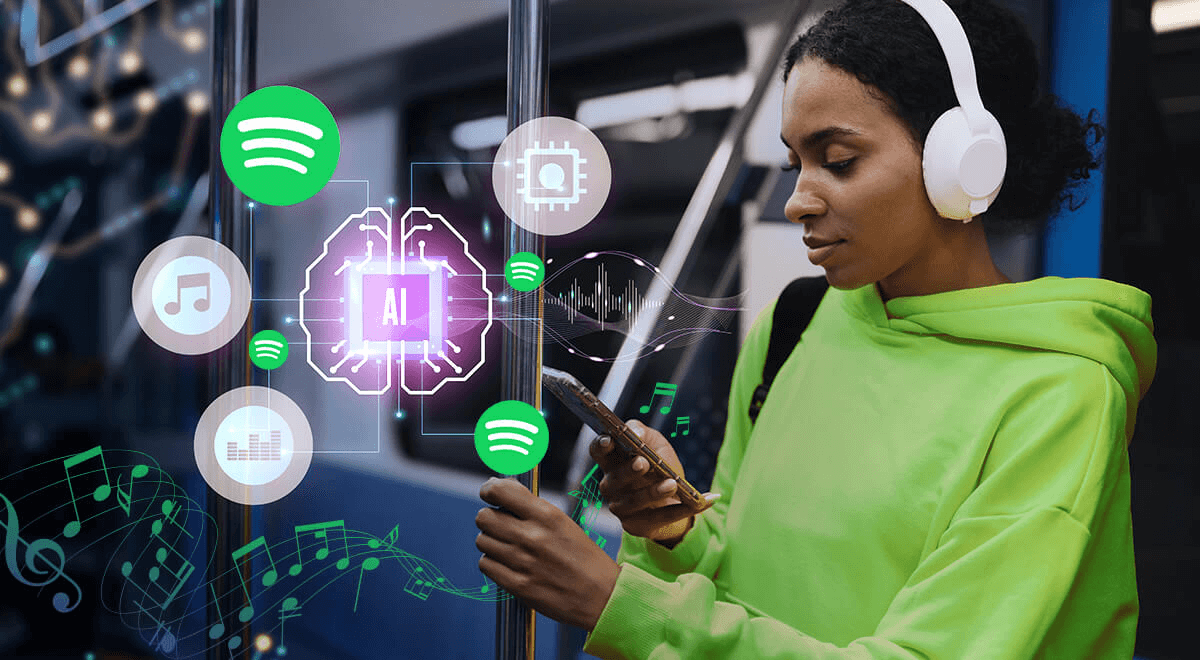
One of the ways Spotify stays relevant is through its sophisticated use of artificial intelligence to understand user behaviour and preferences. Spotify's AI recommendation engine, which powers personalised experiences such as AI Playlist and Discover Weekly, applies a data-first, user-behaviour-led approach to understanding what listeners actually want. Rather than simply responding to what users explicitly search for, its systems learn from signals such as plays, skips, saves and refinements to continuously improve recommendations (Spotify Research, 2025).
While this recommendation engine is not an SEO strategy in itself, the underlying principle is highly relevant to modern search: understanding intent rather than simply matching keywords.
And that distinction matters.
Search has evolved far beyond simply placing the right keywords on a webpage. AI is changing how search engines interpret queries, how businesses create and optimise content, and how users discover information online. Semrush's analysis of more than 10 million keywords found that queries triggering Google's AI Overviews grew rapidly at the beginning of 2025 before settling at around 16% of all queries by November (Semrush, 2025).
At the same time, AI-driven traffic grew 66% throughout 2025, although it still represented less than 0.15% of total web visits (Semrush, 2026).
So, what does this mean for SEO?
Traditional SEO often revolved around keywords, backlinks and technical optimisation. While these fundamentals still matter, search engines have become significantly better at understanding context, intent and meaning.
Google's use of AI in search began with RankBrain in 2015, its first machine-learning ranking system, which helped Google handle queries it had not encountered before. Since then, Google has introduced increasingly sophisticated AI systems, including BERT in 2019 for better language understanding, MUM in 2021 for more complex multimodal and multilingual queries, and AI Overviews in 2024, which generate AI-powered summaries directly within search results. Today, AI is not an add-on to Google Search. It is increasingly embedded in the way every query is processed (DemandSphere, n.d.).
For businesses, this means SEO needs to evolve too.
The goal is no longer simply to rank for a keyword. It is about creating content that clearly answers the questions people are asking, demonstrates genuine expertise and provides useful information that search systems can understand and surface.
Spotify is one example of how AI can turn behavioural data into highly personalised experiences.
Spotify's AI systems learn from interactions such as plays, skips, saves and playlist refinements to understand individual listening preferences. Its research shows how these signals can be used to continuously improve personalised recommendations and generate playlists that better match a user's intent and preferences (Spotify Research, 2025).
The lesson for SEO is not that Spotify is simply "using AI for SEO." Rather, it demonstrates the value of understanding what users mean, not just what they type.
Booking.com takes a similar approach to travel discovery.
Working with OpenAI, Booking.com integrated GPT models with its own property, pricing and availability data to create its AI Trip Planner. The prototype went from concept to launch in just 10 weeks, allowing travellers to use natural-language prompts to discover destinations and build personalised itineraries (OpenAI, n.d.).
This represents a shift from traditional search behaviour. Instead of forcing users to know exactly what keywords, filters or destinations to enter, AI can interpret open-ended requests and connect them with relevant information.
For marketers, this shift is important.
The future of search is increasingly about intent, context and usefulness, rather than keyword matching alone.
AI can support SEO in several areas, helping marketers move from reactive optimisation to more adaptive and data-driven strategies.
AI can analyse historical search and behavioural data to identify patterns and predict potential changes in search behaviour.
Rather than waiting for a keyword to become popular, businesses can use these insights to identify emerging topics, changing consumer interests and potential content opportunities earlier.
This allows SEO teams to make more informed decisions about what to create, optimise and prioritise.
Search is no longer limited to typed queries.
Voice search, image search and increasingly conversational AI interfaces are changing how people discover information. AI can help businesses understand these different search behaviours and optimise content accordingly.
This could mean creating content that answers conversational questions, improving image metadata and accessibility, structuring information clearly, or ensuring important product and business information is easy for machines to understand.
AI can help marketers accelerate parts of the content creation process, from identifying topics and generating outlines to developing first drafts, product descriptions and content variations.
But faster content does not automatically mean better content.
Human expertise remains essential for adding originality, brand perspective, credibility and context. AI should help marketers work more efficiently, not replace the thinking behind the content.
There is already evidence of the commercial impact. Semrush reports that 68% of businesses see an increase in content marketing ROI from using AI, while 65% report better SEO results (Semrush, 2024).
Search behaviour, algorithms and user expectations are constantly changing.
AI allows businesses to analyse large volumes of data and identify changes faster, helping SEO teams adjust their strategies based on new search patterns, audience behaviour and emerging opportunities.
Instead of treating SEO as a set-and-forget activity, businesses can build a more responsive strategy that evolves alongside the digital landscape.

If you're looking to incorporate AI into your SEO workflow, several tools can support different stages of the process.
AI can process enormous amounts of data, identify patterns and automate repetitive tasks at a speed humans simply cannot match.
But data alone does not create meaningful content.
Human expertise is still needed to understand why an audience cares, which insights are worth pursuing, what a brand should stand for and how information should be communicated in a way that feels relevant and authentic.
That is why the strongest SEO strategies will not be built around AI alone.
They will combine AI's ability to analyse and adapt with human creativity, judgement and empathy.
Spotify's recommendation systems show how continuously learning from user behaviour can create more relevant experiences. Booking.com's AI Trip Planner demonstrates how combining AI with proprietary data can help users move from vague intent to meaningful discovery. And Google's evolution from RankBrain to AI Overviews shows that search itself is becoming increasingly AI-driven (DemandSphere, n.d.; OpenAI, n.d.; Spotify Research, 2025).
For businesses, the takeaway is clear: SEO is no longer just about getting people to your website.
It is about understanding what people are looking for, creating genuinely useful content, and making your brand easier for both people and intelligent systems to discover, understand, and trust.
AI may be changing how search works, but the brands that win will still be the ones that understand people.
References:




March 21, 2024

April 4, 2024

February 29, 2024

 Thank you for your enquiry! We'll respond shortly.